
Mastering First Principles Thinking: Part 2
In today's piece, I dive deeper into first principles thinking and share 10 more insights from my approach to product management

In our last exploration of first principles thinking, I peeled back the layers of my approach to applying this concept in product management—revealing insights from my experience that (may) challenge conventional wisdom.
If you missed Part 1, I encourage you to revisit those foundational principles here before diving into this sequel. For those who have been waiting, buckle up- we're about to go deeper!

Here are my next top 10 first principles thinking about product management.
Process Adaptability is Your Competitive Advantage: Rigid methodologies are organizational constraints. Every team has a unique DNA which will require a custom-tailored approach. You must continuously experiment, measure, and recalibrate your approach to solving problems. In my experience, the most successful product organizations treat their processes like living, breathing entities—constantly evolving.
Ego is the Enemy of Innovation: True product leadership demands intellectual humility. Your role is not to be right but to discover what is right. Prioritize data over opinion. Treat every assumption as a hypothesis waiting to be validated. Foster and embody a culture where challenging ideas isn’t just permitted—it’s expected.
Minimalism is Strategic Sophistication: Complexity is often a camouflage for lack of clarity. The most powerful products solve complex problems through elegant simplicity. Whether in engineering, marketing speak, or design, your benchmark should always be: "What's the least I can do to create maximum impact?"
Storytelling Beats Documentation: Product communication is about inspiring, not just informing. Ensure you are actively transforming abstract concepts into clear narratives. Your ability to paint distinct pictures of what the future will look like when you solve a problem will align teams, excite stakeholders, and rally customers more effectively than any technical specification or JIRA ticket.
Redefine Failure as Organizational Learning: Every time I have created psychological safety, I have seen a lot of creativity and innovation. Treat each "unsuccessful" attempt as a data point, not a defeat. Build mechanisms to rapidly capture insights, share learnings, and pivot quickly.
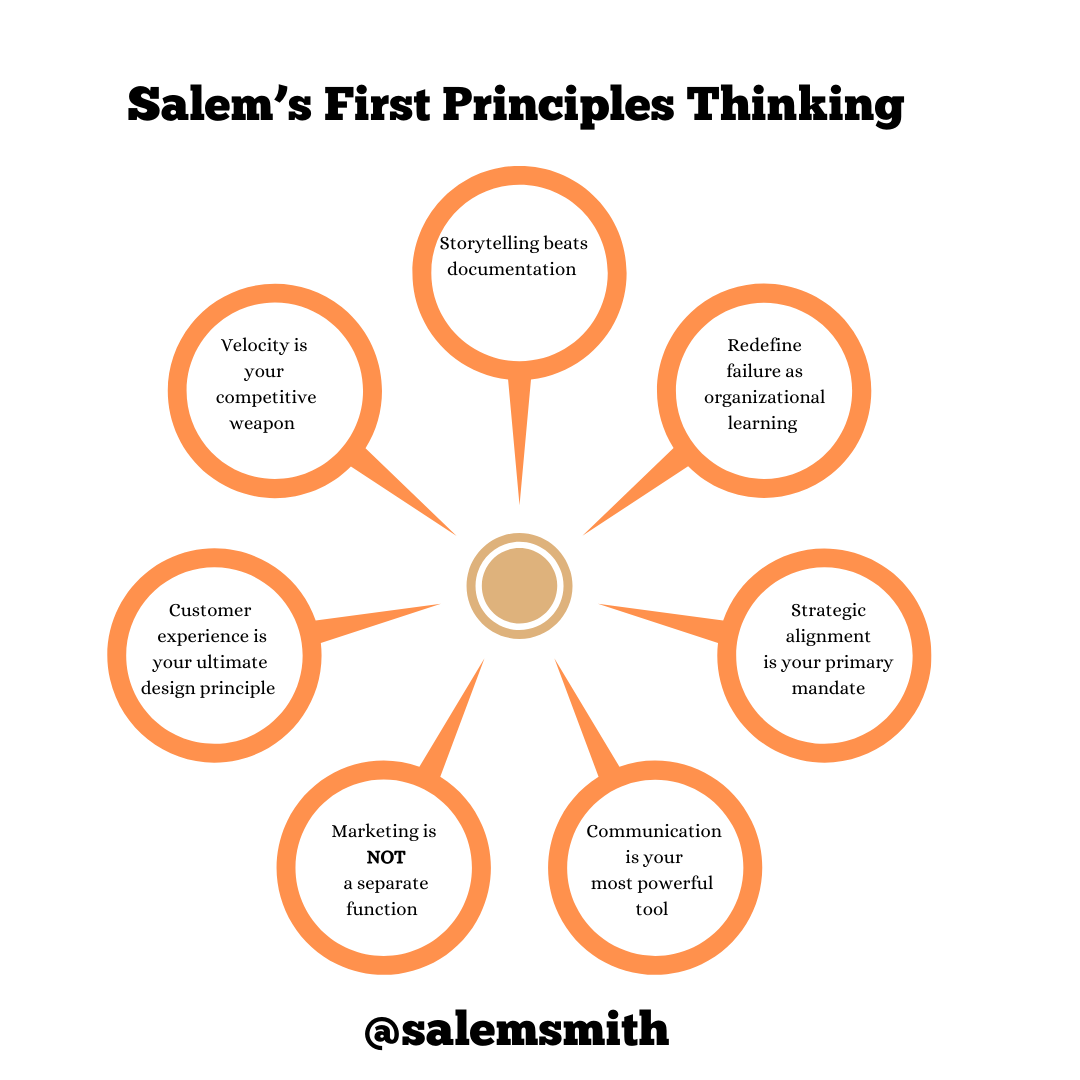
Strategic Alignment is Your Primary Mandate: Your core responsibility goes beyond product features. Your role is critical to ensuring business objectives, customer needs, and team capabilities are perfectly in sync. This requires constant calibration, communication, and sometimes difficult trade-off decisions.
Communication is Your Most Powerful Tool: Recognize that each function speaks a unique language. Your role is to be a universal translator and relationship architect. Deep understanding is not just about information exchange; it's about building trust, empathy, and a shared vision across multiple teams.
Marketing is Not a Separate Function—It's an Extension of Product: If you observe a sizable number of mature product organizations, Product Managers are required to know how to sell their products. Modern product leadership should blur traditional boundaries. It is your responsibility to understand marketing not just as a channel for promotion, but as a critical feedback loop for product strategy. Your product's narrative, positioning, and user perception are just as crucial as its technical capabilities.
Customer Experience is Your Ultimate Design Principle: Never make users work to understand your product. If explanation is needed, your design has failed. Strive for intuitive, frictionless experiences that feel almost magical in their simplicity.
Velocity is Your Competitive Weapon: In a world of rapid technological change, speed isn't just an advantage—it is survival. Create systems that enable quick decision-making, rapid prototyping, and agile response. Your organizational metabolism determines your market relevance.
These principles are not theoretical by any means—they are battle-tested insights from the frontlines of my experience leading product teams. They are indicative of my mindset and more than what you might read in a product management book.
Which of these resonated most deeply with you? I'm genuinely curious.
Drop a comment below sharing your perspective, a counterpoint, or a story from your own product journey.
And if you found value? Share this with one product leader who needs to read this. Let's continue pushing the boundaries of what great product management truly means!
Stay curious. Stay bold.